Knowledge Graphs at SystemWeaver
Posted: June 5, 2024

Knowledge Graphs at SystemWeaver
Knowledge Graph (KG) is a means of presenting knowledge in a graph format where nodes represent real-world concepts, and edges encode relationships or connections among them. Since computers can effectively process KGs, they are widely used in various applications e.g., search engines, recommendation systems, fraud detection systems and most recently generative AI-powered systems.
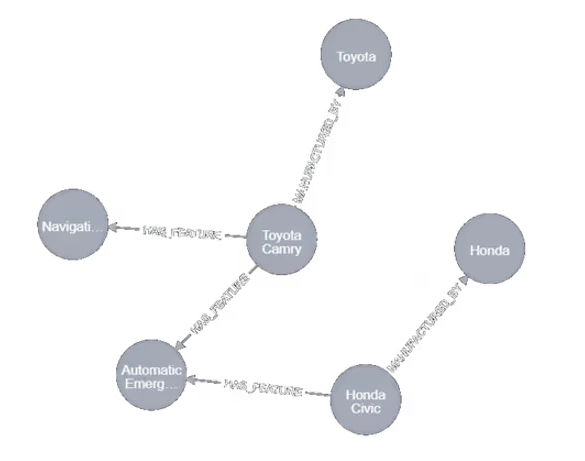
Below, you can see an example KG in the automotive context. In this KG, car models, features and manufacturers are represented as nodes and the edges entail the relationship among them. For example, Toyota Camry is connected to Toyota through the manufactured_by relationship, indicating that Toyota is the manufacturer of Camry. Additionally, it is connected to Navigation System through the has_featurerelationship meaning that it has such a feature.
At SystemWeaver we use KGs within the context of automotive cybersecurity. We have cybersecurity data stored in different databases in different formats. The data includes information about system assets and vulnerabilities, security controls, attack vectors and attack patterns. We integrate these data elements into a KG which is then stored into a graph database. This way we can analyze dependencies and reveal potential attack paths more efficiently.
SystemWeaver’s Cybersecurity module currently supports our customers with a cybersecurity risk assessment process called Threat Analysis and Risk Assessment (TARA). TARA is a critical component of the cybersecurity management process recommended by ISO/SAE 21434 for road vehicles. Our plan is to enrich the CyberSec module with the cybersecurity KG together with graph analytics and machine learning techniques. This way, we can help our customers get a more comprehensive understanding of cybersecurity threats and risks, and benefit from useful recommendations throughout the TARA process.