Engineering Sovereignity
Beyond data sovereignty is the knowledge that defines your products.
Data sovereignty is about controlling where data resides and who can access it. Engineering Sovereignty goes further. It is about retaining control over the product knowledge, engineering logic, methods, toolchain and AI that determine how complex products are designed, changed, verified and evolved over time.
For organizations building software-defined, connected and regulated products, engineering sovereignty is a strategic capability. Engineering knowledge is increasingly distributed across models, requirements, software, tests, decisions, variants and AI-supported workflows. Losing control of that context can create dependencies that are much harder to reverse than simply moving data between systems.
SystemWeaver provides a stable foundation for that engineering knowledge. Its configurable metamodel lets organizations define their own structures, terminology, relationships and processes, instead of adapting to a vendor-defined engineering model. A connected, version-controlled product model preserves requirements, architecture, software, tests, variants, decisions and traceability as long-lived organizational knowledge.
Its open, API-first architecture lets surrounding tools, suppliers and technologies evolve without losing the engineering backbone.
This becomes even more important in the AI era. SystemWeaver makes the trusted product model the governed foundation for AI-assisted engineering, controlling what AI can access, what it may change, how changes are verified and approved, and which AI models or infrastructure are used.
The result is maximum technological choice with minimum loss of engineering control.
Product, engineering knowledge and AI, all by your own rules.
One live product model
Systems engineering and software development no longer operate as separate disciplines.
In modern vehicles, machines and autonomous systems, product behavior emerges from the combination of physical architecture, electronics, software, and increasingly AI, so the engineering model needs to connect more than requirements and system architecture.
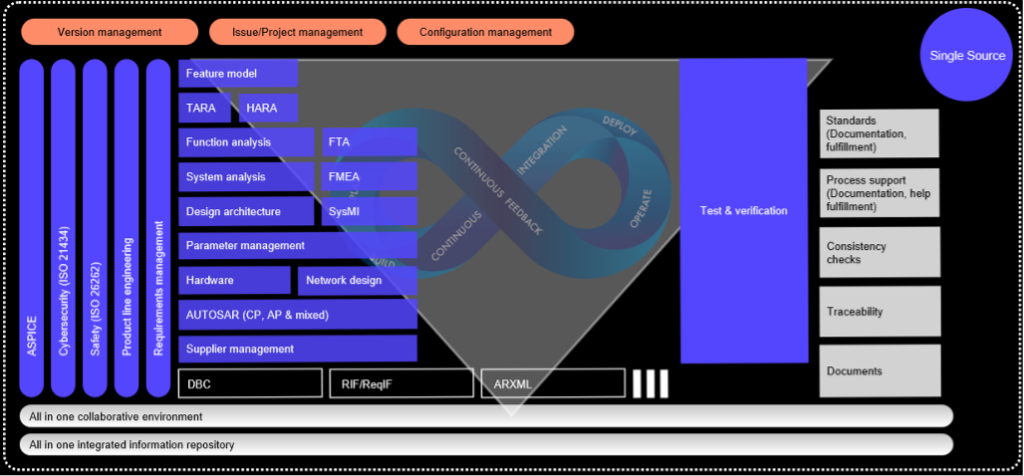
SystemWeaver connects MBSE, software architecture, code assets, and the software development lifecycle as one engineering context: a One Live Product Model. A requirement traces through functions and system architecture to software components, interfaces, implementations, tests, and releases, so engineers always see how a software change relates to the system as a whole.
Code repositories and development platforms stay exactly where they are. SystemWeaver’s graph-based information model connects their relevant assets by pointer rather than by copy, so nothing is duplicated and every link stays explicit and navigable. This structure keeps traceability intact across disciplines, organizational boundaries, and multiple product variants developed in parallel.
Over time, this becomes more than a digital thread: a continuously evolving representation of both what the product is and how it is being built, kept alive by the work of the teams building it, one model connected to the engineering ecosystem around it.
Built to Scale
Complexity, teams and data grow. AI multiplies the workload.
The engineering foundation should not become the bottleneck.
Scaling complex product development is about more than supporting more users. It means preserving speed, responsiveness and control as product structures, variants, data volumes, integrations and automation all grow at the same time.
For organizations developing software-defined and increasingly complex products, this is a fundamental platform requirement. More engineers work in parallel, more systems exchange data continuously, and AI introduces entirely new levels of activity across the engineering lifecycle.
SystemWeaver is built for this kind of scale. Its graph-based product model keeps requirements, architecture, software, tests and dependencies connected without unnecessary duplication. Engineers work in parallel on a shared, version-controlled foundation, maintaining traceability and consistency across the product.
The platform also uses infrastructure efficiently. High-performance data access, efficient client-server communication and modern concurrency patterns let many users and services work with the same product model without unnecessary contention.
As workloads increase, the architecture evolves with them. Distributed deployment, load balancing, caching and materialized representations serve frequently used information efficiently for analytics, integrations and AI, without forcing every workload through the same path.
AI raises the bar further. Automated assistants and agents generate far more interactions with engineering data than human users alone.
The goal is simple: let product complexity, engineering activity and intelligence grow without the platform becoming the limiting factor.
LET’S TALK