White Paper: Model-Based Systems Engineering
Posted: September 21, 2026

Unmanaged Complexity is the Real Bottleneck for Innovation
System complexity has exploded. The industries that build the world’s most complex, safety-critical products have undergone a fundamental shift over the past decade: products have become software-defined.
The challenge now is maintaining consistency and quality while hundreds of engineers change and innovate in parallel. The product architecture, performance, innovation, safety, cybersecurity, and variants must align during continuous product updates and strict regulatory cycles. The integration of AI and structured data adds a significant dimension to these processes, as AI effectiveness is fundamentally tied to the availability of large volumes of relevant, high-quality information.
The organizations that will lead over the next decade are the ones that build a single, unified product backbone across requirements, architecture, and software.
Compliance is treated as an ongoing engineering capability, and variants are managed systematically at scale. Organizations without this foundation will keep fighting fragmented toolchains, late compliance surprises, and will struggle to maintain the speed of innovation required to stay competitive.
From Fragmented Toolchains to a Shared Foundation
Leading engineering organizations work in a shared, live product model where requirements, architectural decisions, safety analyses, and test results are connected.
When something changes, the impact is visible across all domains immediately. When a regulator asks for traceability, when an architectural decision needs to be revisited, when a new variant or platform configuration needs to be launched, the organization can respond in hours.
Compliance is built into the engineering process from the start, so innovation and continuous compliance can be maintained for products with lifecycles spanning decades.
SystemWeaver was built for exactly this, with decades of engineering and patented innovations behind a structured, version-controlled product model designed to hold together at scale.
OBSTACLES TO OVERCOME
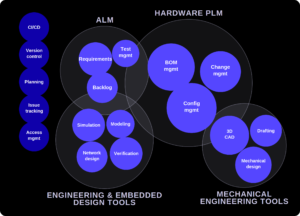
Tools that control engineering, rather than support it.
Most engineering tools impose fixed data models and predefined workflows. When an organization needs to evolve its structures or adapt how work is done, the result is vendor dependencies, reconfiguration projects, and workarounds. Reuse suffers; components get copied, variants diverge, and knowledge is lost between programs.
A product that exists on paper, not as a live model.
Engineering information is spread across requirements tools, architecture tools, software repositories, test systems, documents, and spreadsheets. Relationships between them are described in specifications and meetings but not maintained as the system evolves. As more engineers work in parallel, consistency breaks. The full picture often only becomes clear when it is already too expensive to change.
Engineering data trapped inside tool boundaries.
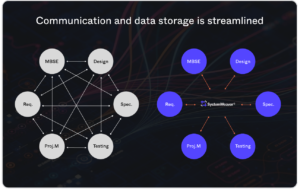
Each tool holds a piece of the product, but data does not flow between them. Integration is manual and brittle. Collaboration with suppliers and partners is reduced to document exchange instead of shared product data. Most tools were not designed for thousands of engineers working on the same model across locations and time zones. As complexity grows, the toolchain becomes a bottleneck.
The effect is that organizations introduce more meetings, more reporting, and more governance layers. Engineering effort shifts from building the product to coordinating the organization.
Three Foundational Shifts in System Engineering
SystemWeaver was built to solve one specific problem: how to manage and maintain consistency in complex, software-defined products, across large organizations, over long lifecycles.
This is a structural problem that will not be solved with marginal improvements or optimizations. Addressing it requires rethinking how engineering information is structured and managed at scale.
OWN YOUR ENGINEERING MODEL
Most engineering tools are built around fixed data models and predefined processes. That works in simpler environments but breaks down in large organizations where structures evolve, processes differ across domains, terminology varies between teams, and change is continuous over long lifecycles.
SystemWeaver is built around a configurable metamodel where the organization defines the rules, not the tool vendor, with the ability to evolve them continuously as part of engineering work.
Flexible, transparent, and configurable metamodel.
Organizations define their own product structures, relationships, enginering artifacts, and lifecycle states. No predefined schema.
Semantic control
Terminology, structures, and enginering logic are defined within the system. Thenginering language is embeded where the work hapens.
Proven at scale
Deployed across large OEM programs where structures, proceses, and terminology difer acros brands andomains, suporting continuous evolution over 20+ year product lifecycles without data migration.
WORK ON ONE CONNECTED, UNIFIED PRODUCT MODEL
Engineering information today is spread across requirements tools, architecture tools, software repositories, test systems, documents, and spreadsheets. Relationships between these tend to live in specifications and synchronization meetings, making them hard to maintain as the system evolves. The product exists in theory but not in a consistent, live form.
SystemWeaver holds the entire product in one version-controlled model, where relationships between parts are maintained as the system grows and changes.
Fully open API layer
Direct programmatic access to all engineering objects and relationships, with integration patterns for requirements tools, code repositories, test systems, and PLM environments.
Reduced administrative overhead
The use of a single live model minimizes the need for manual synchronization and governance layers between diverse engineering domains.
Distributed data synchronization
Consistency across sites, support for parallel work, and controlled propagation of changes across distributed teams.
Efficient client-server communication (patented)
The client determines which parts are needed for a given view; the server sends all required data in a single response.
Integration database framework (patented)
A graph-based integration model that structures linked data across distributed sources.
CONNECT EVERYTHING AND RE-DO NOTHING
Engineering data trapped inside tool boundaries becomes a silo. A toolchain that cannot handle real-world scale becomes a bottleneck for the entire organization.
SystemWeaver is built API-first and designed for in-memory performance, allowing the platform to serve as a shared foundation for large, multidisciplinary teams.
This model-based collaboration reduces the reliance on manual reporting and coordination meetings, ensuring that the engineering ecosystem remains focused on innovation as the organization grows.
Fully open API layer
Direct programmatic access to all engineering objects and relationships, with integration patterns for requirements tools, code repositories, test systems, and PLM environments.
Fully open API layer
Direct programmatic access to all engineering objects and relationships, with integration patterns for requirements tools, code repositories, test systems, and PLM environments.
Reduced administrative overhead
The use of a single live model minimizes the need for manual synchronization and governance layers between diverse engineering domains.
Distributed data synchronization
Consistency across sites, support for parallel work, and controlled propagation of changes across distributed teams.
Efficient client-server communication (patented)
The client determines which parts are needed for a given view; the server sends all required data in a single response.
Integration database framework (patented)
A graph-based integration model that structures linked data across distributed sources.
This Requires Commitment
Establishing a structured, product-centric engineering foundation requires alignment across teams and domains, changes in how engineering work is performed, and a step-by-step approach to scaling.
Strong engineers are rarely the limiting factor. What is missing is a foundation that allows them to work in a coordinated and scalable way.
SystemWeaver was founded over 25 years ago by engineers who saw this problem early: software-defined product development would require a fundamentally different approach to managing engineering information. The platform, the patents, and the methodology all come from working inside this problem for two decades.
About Us
SystemWeaver provides a centralized platform for managing product overviews, tracking, and functionality. Effective management of the entire lifecycle of a software product requires a system-level approach that encompasses all stages, from conception through design, manufacturing, service, and disposal.